
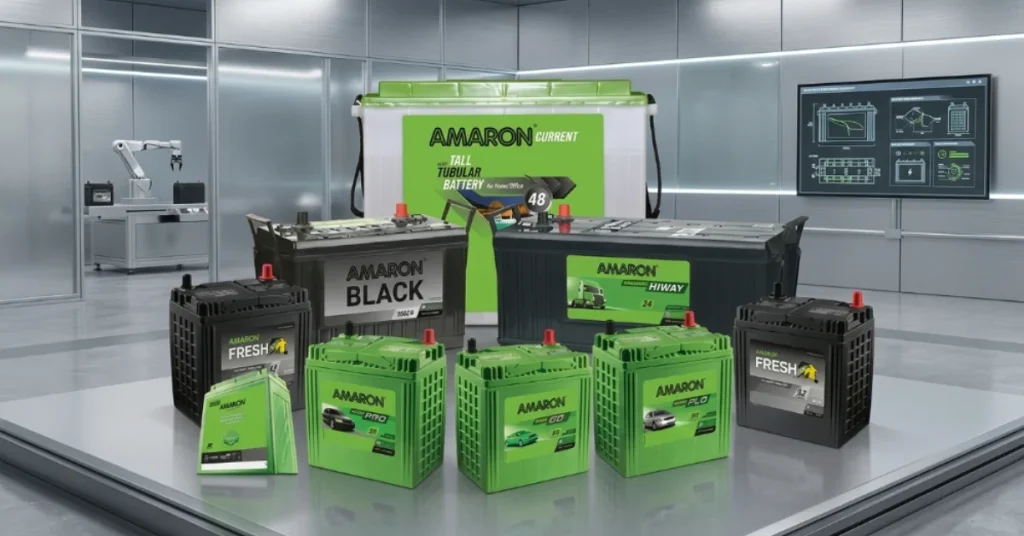
Picking the wrong car battery can leave you stranded on a hot morning with an engine that just won’t start. Every Amaron battery carries a code on its label, and once you know how to read it, buying the right one becomes simple.
Amaron battery sizes are based on two main systems: JIS, common in Japanese and Asian cars, and DIN, used mostly in European vehicles. A code like 55B24LS indicates the battery’s power class, case width, length, and terminal side.
Bigger cars with diesel engines or more electronics usually need higher Ah and CCA ratings, while small hatchbacks work fine with smaller, lighter units. Knowing this code helps you match the battery tray, terminal position, and power output to your exact car model.
What Do the Numbers and Letters Mean?
Every JIS battery code follows a pattern that looks confusing at first but is actually easy once broken down. Take 55B24LS and 80D26L as two examples to see how the code works.
Reading the code, part by part:
- Performance number (55 or 80): Shows the performance class, meaning how much starting power and capacity the battery holds. A bigger number means stronger cranking power and higher Ah capacity.
- Case letter (B or D): Tells you the width and height of the case. B series batteries are narrower, while D series batteries are wider and taller, built for cars with higher electrical loads.
- Length number (24 or 26): Gives the length of the battery in centimeters.
- Terminal position (L or R): Shows which side the positive terminal sits on.
- Extra letter (S): Seen in codes like 55B24LS, this means the terminal is a thicker, standard type rather than a slim one.
55B24LS at a glance:
- Delivers around 45 Ah and 360 to 380 CCA
- Fits mid-size sedans
- Has a left-side positive terminal with thick standard posts
80D26L at a glance:
- Offers around 60 Ah and close to 500 CCA
- Fits a wider D-size case meant for bigger sedans and mid-size SUVs
- Also has its positive terminal on the left side
Both codes follow the exact same reading pattern, just with different numbers and letters representing different power and size needs.
JIS vs DIN: What's the Difference?
JIS and DIN are two different battery standards, and knowing which one your car needs is just as important as picking the right size. JIS batteries are common in Toyota, Honda, Nissan, and Suzuki models, and they usually have raised terminal posts on top.
DIN batteries, on the other hand, are the standard fit for Volkswagen, BMW, Audi, Mercedes, and Ford cars. DIN units tend to be wider and shorter, with recessed terminals set slightly into the case body for a tighter, safer connection.
Mixing up these two types can cause fitting problems, loose terminal connections, or a battery that simply won’t sit properly in the tray.
How do JIS Codes Work?
JIS codes are written as something like 42B20L or 95D26L. The starting number shows overall performance, meaning a bigger number gives more starting power and running capacity.
The letter that follows, either B or D in most passenger cars, shows the case profile, with B being narrower and D being wider and taller. The two digits after the letter give the case length in centimeters.
The last letter, L or R, tells you where the negative terminal sits, which matters a lot because a wrongly placed terminal makes it hard to connect the cables without stretching them.
How do DIN Codes Work?
DIN codes are much shorter and simpler to read, usually written as DIN55, DIN66, or DIN74. The word DIN itself confirms it follows the European sizing standard, and the number that comes after directly tells you the Ampere-Hour, or Ah, rating of the battery.
So a DIN66 battery holds 66 Ah of capacity. These batteries usually come with recessed terminals, which sit lower than the top surface of the case, giving extra protection against accidental short circuits during handling or installation.
Common Amaron Battery Sizes and Their Uses
Different cars need different battery sizes depending on engine size, electrical accessories, and climate conditions. Below is a simple table showing popular Amaron battery models, their capacity, cold cranking amps, dimensions, and the type of vehicles they usually suit.
Battery Model | Capacity (Ah) | CCA | Dimensions (L x W x H, mm) | Common Vehicle Use |
42B20L (NS40ZL) | 35 | 335 | 197 x 129 x 227 | Small hatchbacks, compact sedans |
55B24L / LS | 45 | 360 | 238 x 129 x 227 | Mid-size sedans |
80D26L | 60 | 500 | approx. 260 x 173 x 225 | Mid-size SUVs, larger sedans |
85D23L / R | 60 | 550 | 232 x 173 x 225 | SUVs, larger engines |
95D26L / R | 65 | 600 | 260 x 173 x 225 | Heavy-duty SUVs, large vans |
125D31L / R | 95 | 775 | 306 x 173 x 225 | Large diesel SUVs, trucks |
DIN 45 | 45 | 400 | 207 x 175 x 190 | European hatchbacks |
DIN 55 | 55 | 500 | 242 x 175 x 175 | Compact and mid-size European sedans |
DIN 66 | 66 | 610 | 242 x 175 x 190 | Sedans, medium SUVs |
DIN 74 | 74 | 690 | 278 x 175 x 190 | Mid to full-size European cars |
DIN 88 | 88 | 740 | 353 x 175 x 190 | Large luxury cars, diesel models |
DIN 100 | 100 | 800 | 353 x 175 x 190 | Full-size SUVs, high-end performance |
This chart works as a quick reference guide, but always check your car manual or the old battery label before buying a replacement, since some models come in slightly different variants across regions.
Other Things to Check Before Buying
Beyond just size and shape, a few technical factors decide how well a battery will perform in your car. Cold Cranking Amps, or CCA, measure how much power the battery can deliver to start the engine in cold or difficult conditions.
A higher CCA rating means a stronger, faster start, especially useful during winter mornings or after the car has been parked for a while. Reserve Capacity, or RC, tells you how long the battery can keep the car running on its own if the alternator stops working.
Terminal type also matters a lot, since some vehicles need standard upright posts while others require the recessed European DIN-style terminals.
Why Does Terminal Position Matter?
The terminal position, shown by the L or R at the end of the code, decides which side the positive and negative terminals sit on. Getting this wrong means the battery cables might not reach the terminals properly, or you may need extension cables that can create a safety risk.
Always match the terminal layout of your old battery when picking a new one, since even a battery with the right Ah and CCA rating will not fit correctly if the terminals are on the wrong side.
Final Thoughts
Reading Amaron battery sizes does not need to feel complicated once you understand the pattern behind the code. Each part, from the performance number to the case letter, length, and terminal position, tells you something important about fit and power.
Whether your car needs a compact 42B20L, a mid-range 55B24LS, a stronger 80D26L, or a large DIN 100, matching the exact code to your vehicle manual keeps your electrical system running smoothly and avoids fitting problems.
Always double-check CCA, Ah, and terminal side before making a purchase, since these three details decide how well your new battery will perform in daily use.
If your car battery is old, weak, or giving starting trouble, do not wait for it to fail. 800Sayara offers genuine batteries along with quick Amaron battery replacement services in Sharjah, so you get the right size fitted the first time correctly.


